
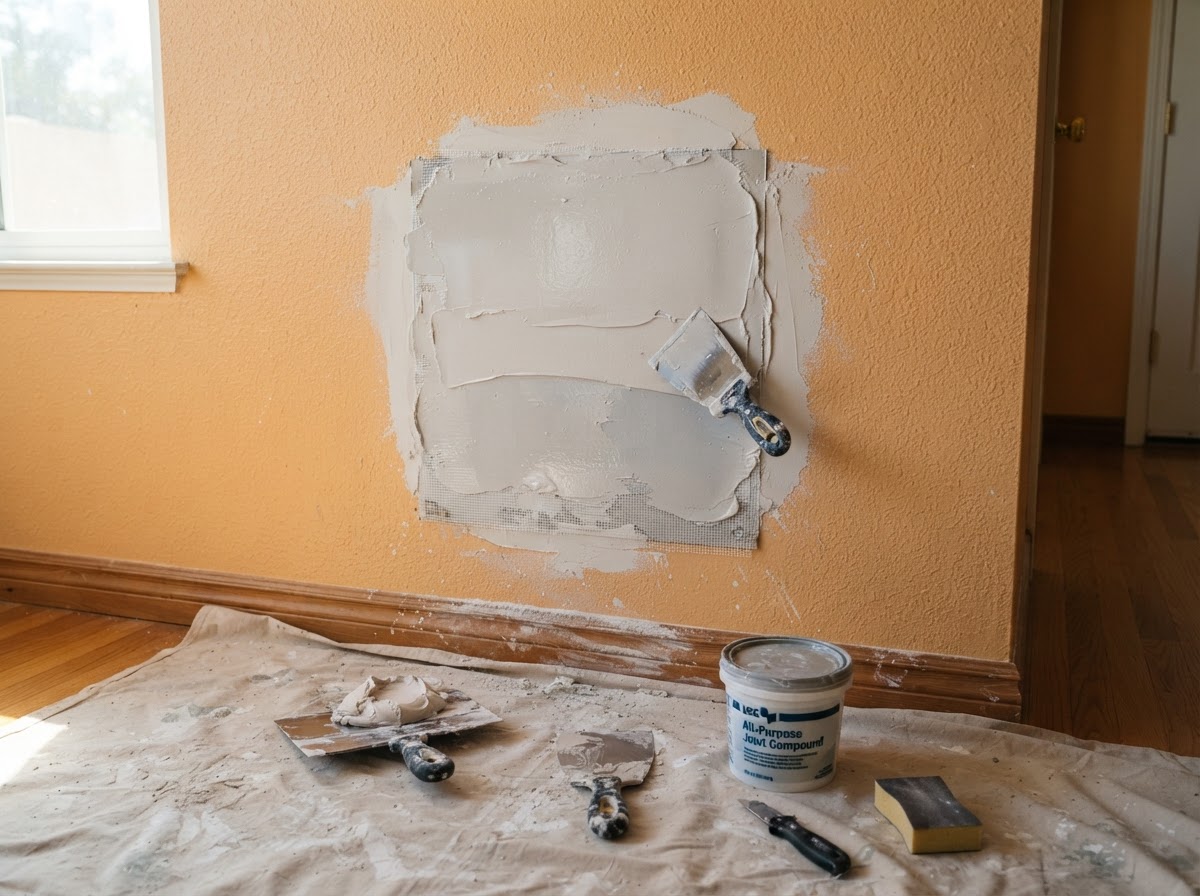
Drywall repair is one of the most common calls we get across Los Angeles, Orange and Ventura Counties — a water stain on a ceiling, a doorknob blowout, a settling crack above a doorway. The first question is almost always the same: what will it cost? Here is an honest, plain-English breakdown of the factors that drive drywall repair pricing in Southern California, and what to expect when you ask for an estimate.
What Actually Drives the Cost of a Drywall Repair
Drywall repair pricing is not a single number. It is a combination of four things: the size of the damaged area, the type and thickness of the board, whether the existing texture has to be matched, and how hard the spot is to reach. A 12-inch by 12-inch patch in the middle of an open garage wall is a very different job from the same patch on a vaulted ceiling over a staircase.
The single biggest variable is almost always access. Repairs that require scaffolding, lifting equipment, or working around cabinetry, plumbing or electrical take longer and cost more — not because the patch itself is harder, but because getting to it and protecting everything around it takes time. That is why we always come out and look at the actual conditions before we quote a number.
Typical Repair Scenarios and Estimate Ranges
Small patches — doorknob holes, settling cracks, nail pops
A small blowout from a door handle, a hairline crack above a window, or a handful of nail pops are the most common repairs. These are usually under a square foot of board replacement and a quick skim-and-blend. In our experience across LA and Orange County homes, small repairs like these typically fall in the lower end of our range. The cost goes up when there are several of them in one room, or when the wall has a heavy texture that has to be matched.
Medium repairs — water damage, large holes, ceiling stains
Water damage is where medium repairs live. A leaking roof, a slow pipe, or an upstairs bathroom leak can stain and soften a section of ceiling or wall that has to be cut out and replaced. The repair itself is straightforward — cut back to solid board, scab in a new piece, tape and finish — but you also have to confirm the source is fixed, or the new board will fail the same way. Medium repairs are our most common drywall work in older neighborhoods like North Hollywood, Glendale and Long Beach, where the housing stock is 60 to 90 years old.
Large repairs — full wall or ceiling replacement
When a whole wall or ceiling section has to come out — a major leak, a remodel opening, or a structure that has been patched too many times — the job moves from a repair into installation territory. At that scale you are paying for board, labor, tape, mud and finish, plus the disposal of the old material. These jobs are usually quoted as a project, not a patch, and we will give you an itemized line for each part.
The Texture Matching Factor
Here is the thing a lot of estimates do not explain: the patch is the easy part. Matching the texture is what makes a repair disappear — or not. If your walls have knockdown, orange peel, or a hand-troweled finish, the new section has to blend into the existing surface or you will see it every time the light hits it. A smooth Level 5 patch in a knockdown room is obvious; a knockdown patch in a smooth room is just as bad.
Texture matching adds time and material, and that is reflected in the price. A repair in a smooth-wall home is usually faster to finish; a repair in a textured home means spraying or hand-applying a matching texture and feathering it into the surrounding area. If you are curious about the finish options, our drywall texture and Level 5 page walks through knockdown, orange peel and smooth finishes in detail.
Water Damage: Why the Cause Matters as Much as the Patch
If you are repairing drywall because of water damage, the patch is only half the job. Before we hang new board, we check that the leak is actually fixed and that the framing behind it is still solid. Replacing drywall over wet or rotting studs just hides the problem until it shows up again — usually worse. In older LA homes with plaster and lath, water damage can also mean the original ceiling needs to come down and be rebuilt in modern board, which is a different scope than a simple patch.
We will always tell you if we think the damage goes beyond the board. If the source is a roof or plumbing issue, we will coordinate with your other trades so the repair does not get covered up before the cause is solved.
Patch vs. Replace: How We Decide
A common question is whether a damaged section can be patched or whether it has to be fully replaced. The rule we use is simple: if the board is soft, crumbling, or stained through more than a small area, it gets replaced. If the damage is a clean hole or a surface crack with solid board behind it, a patch will hold. We never talk a homeowner into a full replacement when a patch will do — but we also will not patch over board that is going to fail.
- Patch when the board is solid and the damage is a clean hole, crack, or surface stain.
- Replace when the board is soft, waterlogged, or the damage spans a large section.
- Always confirm the cause is fixed before closing up a water-damage repair.
Timeline: How Long a Repair Takes
Most small and medium repairs are done in one to two visits: cut and patch on day one, then a return trip to sand, texture and blend once the mud is dry. Larger repairs or full-wall replacements take longer because each coat of joint compound has to dry before the next goes on — usually a day between coats. We will give you a realistic timeline when we see the job, and we show up when we say we will.
What Changes the Final Number
Beyond the patch itself, a few things move the final cost: whether the room is occupied (we have to contain dust and protect floors and furniture), whether the repair is on a ceiling or a wall, how many coats of finish the job needs, and whether paint is included. We do not paint — we hand off a smooth, paint-ready surface — but we will coordinate with your painter so the finish lands clean.