One of the first decisions on any framing project in Southern California is whether to use wood or metal stud framing. They are not interchangeable — each is better at a specific kind of job. We frame both, so this is not a sales pitch for one over the other. Here is how we help homeowners, property owners and general contractors across Los Angeles, Orange and Ventura Counties choose the right material for the right scope.
Where Each Material Belongs
The short version: dimensional lumber belongs in load-bearing residential work — additions, ADUs, second stories, shear walls. Galvanized steel stud belongs in non-load-bearing partitions, commercial interiors, and anywhere moisture, fire rating, or a dead-plumb wall matters more than raw strength. Most projects use one or the other; a few use both.
If you are building a garage ADU in the Valley, you are almost certainly in wood territory. If you are building out a tenant improvement in an office park in Irvine or a retail space in Anaheim, you are almost certainly in metal stud. The decision is usually made for you by the building type and the structural requirements — but understanding why helps you ask the right questions.
Wood Framing: Strength, Cost, and Familiarity
Why wood is the default for residential load-bearing
Dimensional lumber — 2x4, 2x6, engineered joists and beams — carries the structural load of a home. That is its job. When you frame an addition, an ADU, or a second story, the walls, floors and roof have to transfer weight down to the foundation, and wood does that efficiently and economically. It is also what most residential framers, inspectors and architects in Southern California are used to working with.
Wood is forgiving to frame with: it cuts clean, nails up fast, and can be adjusted on site when conditions do not match the plans exactly. For a residential addition where the existing house is not perfectly plumb, that flexibility matters. Our wood framing page covers the residential scope in more detail.
The trade-offs of wood
Wood moves. It shrinks as it dries, expands with humidity, and can twist or crown if it is not sorted properly before framing. In a coastal climate like Long Beach or Ventura, humidity swings can cause nail pops and minor settling cracks over the first year. Wood is also organic — if it stays wet, it can rot or grow mold. Good framing keeps it dry and sealed, but it is a material with a temperament.
Metal Stud Framing: Straight, Stable, and Fire-Rated
Why commercial interiors run on steel
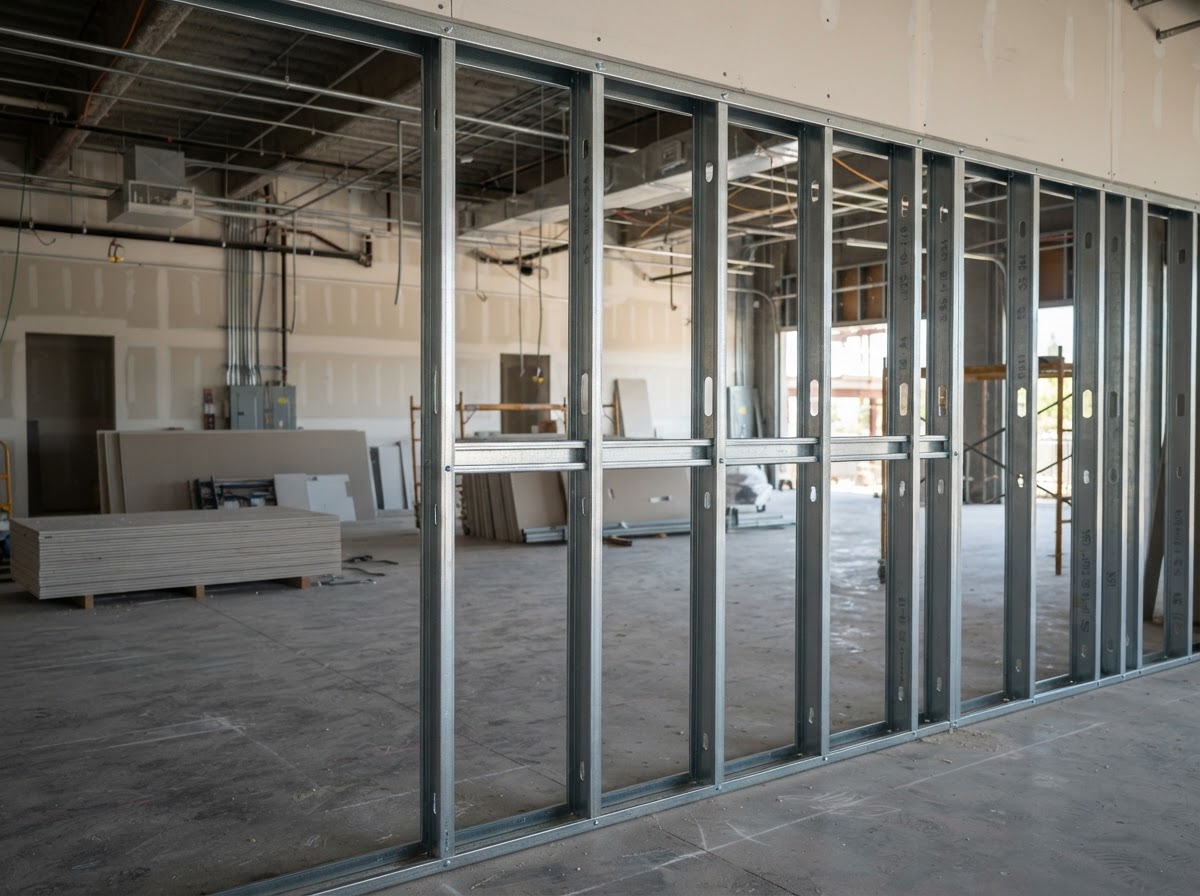
Galvanized steel stud and track is the standard for commercial interior framing for a reason: it is dead straight. A steel stud wall goes up plumb and stays plumb. It does not shrink, twist, or crown, which means the drywall hangs flat and the finish trades do not have to fight the framing. For a tenant improvement where the lease start date is fixed and the finish package has to land on schedule, that predictability is worth a lot.
Steel is also non-combustible, which makes fire-rated and demising wall assemblies simpler to detail and inspect. In an office buildout or retail space where the landlord requires a rated corridor or a separation between tenants, metal stud framing is usually the path of least resistance. Our metal stud framing page goes deeper on the commercial scope.
The trade-offs of steel
Standard metal stud is not structural in the way dimensional lumber is. Light-gauge steel stud can carry some load, but for a load-bearing wall in a home, wood is usually the better and more economical choice. Steel also requires different tools and fasteners, and the framing has to be laid out precisely — there is less room to adjust on the fly. It conducts heat and cold, so thermal bridging has to be considered in exterior walls.
Cost and Availability in Southern California
Material costs swing, but as a general rule dimensional lumber is less expensive per lineal foot than galvanized steel stud for comparable wall assemblies, and the labor to frame with wood is usually faster on residential work. Steel stud can be more cost-effective on large commercial interiors where the speed and predictability offset the material premium, and where the framing has to meet a rated assembly anyway.
Availability in the LA basin is good for both — lumber yards and steel suppliers are close enough that lead times are short. The bigger cost driver is usually the scope and the schedule, not the material itself.
When a Project Uses Both
It is common for a project to use both. A home addition might have wood load-bearing exterior walls and metal stud interior partitions — the exterior carries the roof, the interior just divides rooms. A commercial buildout might have structural steel or concrete for the shell and metal stud for everything inside. We frame both, so we do not have to hand the job off between two crews when the scope crosses the line.
How We Help You Decide
When you call us, we ask about the building type, the load path, the permit requirements, and the schedule. For a residential addition or ADU, the answer is usually wood. For a commercial tenant improvement or buildout, the answer is usually metal stud. For anything in between, we look at the plans and tell you honestly which material serves the job — not which one is easier for us to sell.
- Load-bearing residential walls, additions, ADUs, shear walls → wood framing.
- Commercial interior partitions, demising walls, rated assemblies → metal stud.
- Mixed-scope projects → both, with the load path in wood and partitions in steel.